The case for cocoa tastes sweet
As a grower, following food trends can open doors to new markets, provide an extra income stream, and even reinvigorate your passion for farming.
One crop gaining attention in Queensland is cocoa, which is seeing increasing demand, increasing prices, and an evolving regulatory environment that may benefit Australian growers.
Of course, diversifying isn’t without risk. There are many questions that might go through your mind:
What is the required financial investment for the crop as well as equipment and infrastructure?
What is the learning curve?
Are there easily accessible processing facilities or buyers?
How long until I will see a return on investment on my crop?
What are the business prospects for this crop?
What is the state of the Australian industry for this crop?
How resilient is this crop to future natural disasters?
How resource and labour intensive is this crop?
To explore these questions, we sat down with Chris Jahnke, founding member of the cocoa industry body—Cacao and Chocolate of Australian Origin (CACAO) Limited—and founder of Australian Chocolate P/L, better known Charley’s Chocolate Factory in Mission Beach, Far North Queensland to talk about the future of cocoa growing and chocolate production in Australia.
What we learned was, that no matter which way you look at it, cocoa offers growers an enticing opportunity with a sustainable outlook – both for business and the environment.
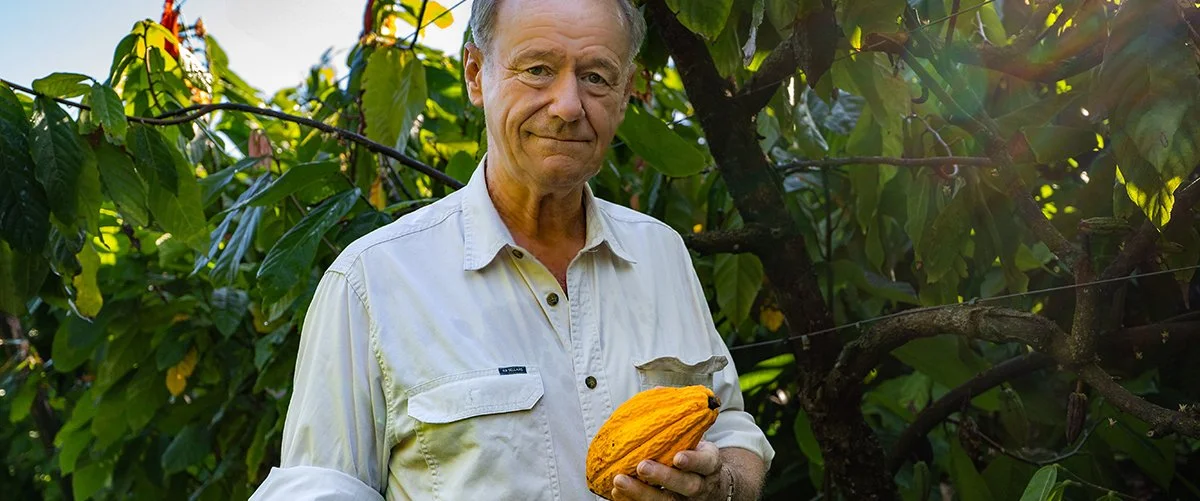
Chris Jahnke. IMAGE: Australian Chocolate
Farming cocoa – “a little peculiar, but just a tree”
From a farming perspective, cocoa isn’t that different from other tree crops. “They all need a bit of TLC when they’re little, some nutrition management, pruning, and pest and disease management. That’s it,” Chris said.
But unlike other tree crops, cocoa offers an advantage - a quicker return. First fruit arrives in about two years, with full production by year four. How quickly and how much yield is influenced by whether the trees are grown freestanding or trellised.
Chris uses a Tatura trellis system. It not only gives the trees support so they can devote their efforts to growing more fruit, sooner, but also acts as mitigation against cyclone damage.
Another cyclone damage-mitigation strategy Chris uses is a defoliant. Cocoa trees have large leaves that are not fond of windy conditions. Using a defoliant means there is less leverage for high-speed winds to knock the trees over, allowing a quicker return to productivity.
“If a cyclone does hit, we’re going to be out of fruit for maybe six or nine months, but it won’t be years,” Chris said.
Those large leaves are useful in other ways. Cocoa trees are self-mulching, reducing the need for chemicals and providing a home for the tree’s pollinators: midges.
The trees’ shallow root system means fertiliser application is light, but frequent, and herbicides are largely redundant. Pest and disease pressures are nothing too exotic, with phytophthora and fruit-spotting bug the main culprits.
Cocoa’s low maintenance needs in terms of chemical and nutrient means the likelihood of runoff flowing into local waterways and the Great Barrier Reef is greatly reduced.
Farming in harmony with the surrounding ecosystem is something Chris is attuned to. As well as his proximity to the Reef, he points out that the surrounding rainforest is home to many important flora and fauna, namely cassowaries.
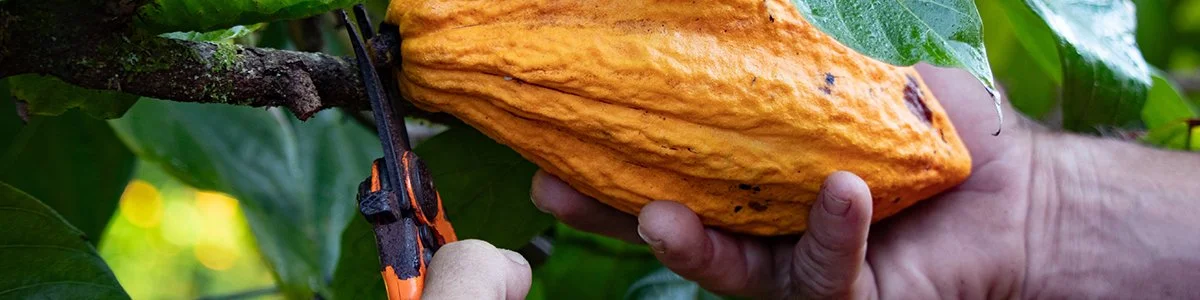
IMAGE: Australian Chocolate
Harvesting and labour considerations
When the cocoa pods turn yellow, that means it’s time to harvest. This happens about six to eight times a year, which is a win in terms of reduced labour costs and reduces risk if a natural disaster occurs at harvest time.
As well as harvest, pruning is the other more labour-intensive task associated with the crop, especially with younger trees that must be done by hand. But once a plantation is established, mechanical pruning followed by a tidy by hand is all that’s needed.
The business case
For Chris, who started growing cocoa on what was a cattle property in 2012, the potential for the industry to grow was a key motivator. Noticing the premiumisation trends in wine, beer, and coffee, the gap in chocolate was obvious.
Today, Charley’s has around 4,000 bearing trees as well as thousands more being propagated in their nursery.
To fulfill the premiumisation prophecy, they also process the beans, manufacture their premium chocolate wholesale to around 80 retailers, and operate an online shop as well as a physical store for visitors to taste and purchase the locally grown and created sweet treats.
To complement the locally grown cocoa, Charley’s incorporate other local and native ingredients into their creations including coconut, pineapple, macadamia, Davidson’s Plum, and Lemon Myrtle.
Chris’ pioneering work and extensive industry knowledge, as well as research into cocoa varieties and genetics by the Department of Primary Industries at South Johnstone provide a solid foundation for new entrants to build upon.
While growing cocoa does not require such a shift in thinking and infrastructure for farmers, the investment needed for second and third stage processing may give some farmers pause.
Having already invested in the processing equipment, Chris wants to continue offering processing services to growers to help fill the growing demand for Australian grown cocoa.
Currently, Chris estimates that there are approximately a dozen Australian commercial scale cocoa growers, with an area of about 15 to 20 hectares.
He says the long-held industry goal to fulfill demand for local cocoa is to reach 1,000 hectares.
“That will give us the volume to supply the market when opportunities arise, rather than having to say to people, there’s a three-year wait,” Chris said.
“I get a call once a week from people wanting to buy either Australian beans or Australian chocolate to use in other things. And they want to buy cocoa nibs and ceremonial cocoa and all sorts of stuff. And I’m constantly having to say to them, ‘sorry, we’re not going to be able to supply it until about 2027 or 2028,’” he told us.
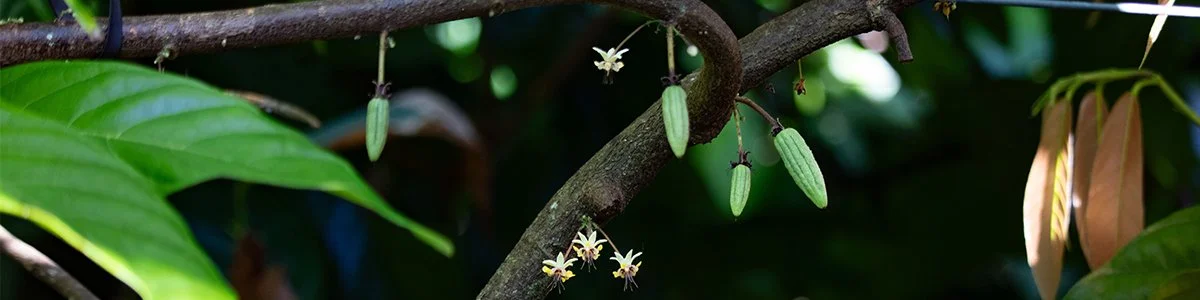
IMAGE: Australian Chocolate
The opportunity for Aussie growers
The evolving regulatory nature of the market further plays into Australian cocoa exporters’ hands.
From 30 December 2025, large businesses in the European Union will need to ensure that land which their imported commodities were produced on were not subject to deforestation or forest degradation since 31 December 2020. Small and micro operations will need to adhere to this requirement from December 2026.
The regulation applies to several commodities and derived products including cocoa and chocolate.
Unlike other cocoa-growing regions such as Asia and West Africa, Australian growers won’t be impacted.
While the local cocoa industry is still working to gain momentum, the farming and business cases for the seemingly exotic crop appear to tick a lot of boxes a curious grower may have.
But, in his understated way, Chris simply puts it, “At the end of the day, it’s just a tree. It’s a little bit peculiar in some ways, but it’s just a tree.